
Keeping the House
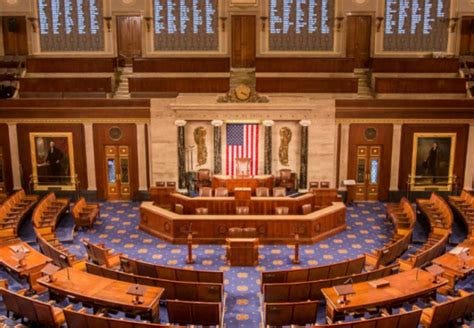
With a blue wave building, Democrats are set to regain control of the House this November. But keeping the House in 2028 will require working on key state legislative races starting now.
By Susan Labandibar
This April, for the first time in seven years, I disconnected from Swing Blue Alliance, a Massachusetts-based grassroots group. When I set off for a three week vacation in France, things at Swing Blue Alliance were going really well. Nothing was falling through the cracks and leaders were leading with no need for me to make decisions. And then, the catastrophic Supreme Court decision on voting rights landed.
The Court’s decision in Louisiana v Callais clearly opens the door to unbridled gerrymandering for partisan gain. The decision won’t solely disenfranchise swaths of black voters. It will have ramifications for voters across the country.
When both Fair Fight and Black Voters Matter sounded the alarm way back in February I was not paying attention. For the last eight years I’ve been preoccupied with winning the next election, not looking at the big picture. Fair Fight and BVM were clear-eyed. They showed that the Louisiana case would end provisions of the Voting Rights Act that would help Republicans lock in one-party control of the U.S. House for “a generation.”
Now I can’t un-see the unfair odds.
In the 2018 midterm elections there were 319 safe seats. With 116 seats in play and 30 tossups, Democrats were able to gain 41 seats. But with 350 safe seats today, it’s almost impossible to recreate that scenario. According to Cook Political report, for Dems to gain 41 seats in November, we’d need to win all the toss-up races, all the lean Republican races and 15 of the likely Republican races, all without losing a single race we’re favored to win.
And as anyone can see, this isn’t over. Republicans are going to keep redrawing the maps to create safe seats. A safe seat is one that Democrats have less than a 2% chance of winning in a normal year.
But there is something you, individually, and we in the grassroots collectively can do. YES, Democrats are favored to win the House in 2026. But in order to KEEP the House in 2028, we need to win key elections at the state level. Read on for highlights of Swing Blue’s “Keeping the House in 2028. (You can read the full plan here.)
Republican Maps, Drawing and Redrawing Congressional Districts
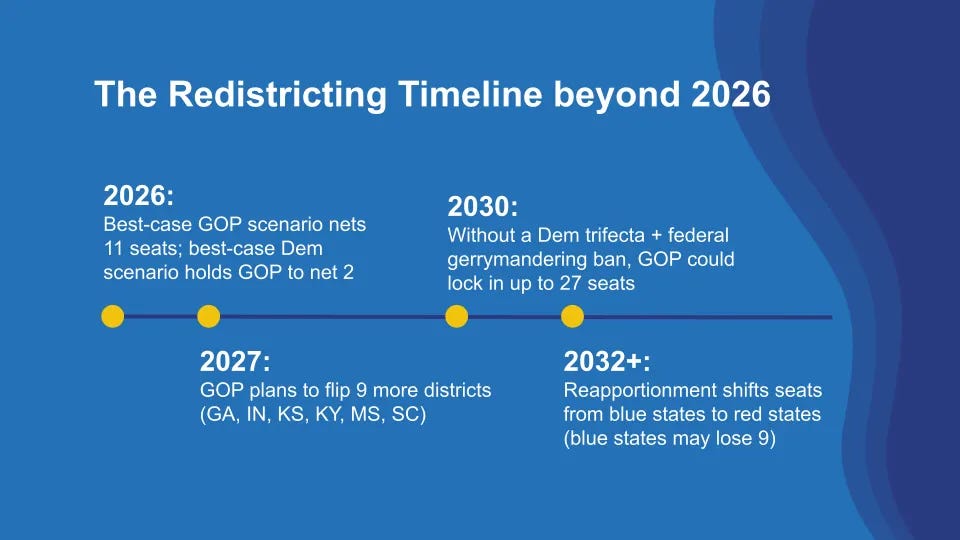
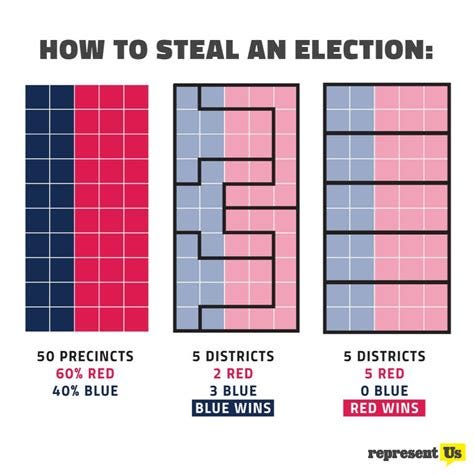
Since 2025, Republicans have redrawn 15 congressional districts for partisan gain. In 2027, Republicans plan to redraw at least nine districts to unseat Democrats in GOP-controlled states, reversing any Democratic gains in the House this November. Redistricting can happen as frequently as lawmakers want it to. Many Republican-controlled states have no independent redistricting commissions and no legal barriers prohibiting mid-decade redistricting or drawing maps for partisan gain.
Countering Republicans’ Moves at the Federal Level
In 2028, if Democrats retake the federal government, they must prioritize restoring and strengthening the Voting Rights Act. They must also enact federal legislation banning partisan gerrymandering outright so that neither party can use district lines as a weapon against voters. These actions at the federal level will have more traction if Democrats control state legislative bodies. Current voter dissatisfaction with the GOP can help us break Republican supermajorities, take back power in purple states and consolidate power in blue states. This will prevent Republicans from implementing unfair maps in many states.
At the State Level
Grassroots work on state legislative campaigns is especially effective, as States Win (formerly known as Sister District) can attest. The impact of every additional voter contact, every extra dollar invested, is far greater in state legislative races than in high profile races where voters likely have more information about candidates and campaign spending is far higher.
Several key grassroots organizations have adopted a long-term strategy to build back power in the states. (See the Allies section below). The challenge will best be met if these groups can join allies in taking and keeping control of state legislatures and governorships.
Here are some ideas on how to get started.
BLUE STATES: Win supermajorities in blue states to lock in power and pass ballot measures to remove legal impediments to partisan gerrymandering.
PURPLE STATES: Win governing trifectas in purple states, prioritizing the defeat of those who allow partisan gerrymandering. Win control of state supreme courts.
RED STATES: Win control of one branch of government in Republican trifecta states or break control of Republican supermajorities to thwart further partisan gerrymandering.
There are many possible places where grassroots resources and pressure could make a huge difference. And grassroots groups should look at where they have existing relationships, proximity, or deep knowledge that weighs on their side. Some examples follow.
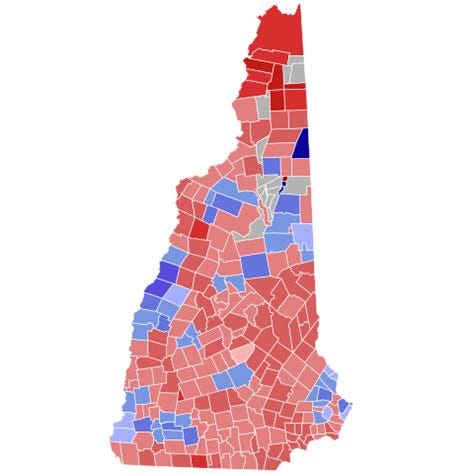
NH–Win control of one branch of government
Flipping the NH House is the easiest way to stop Republicans’ plan to make safer Red-leaning districts in the “Live Free or Die” state. Even though Democrats will need to flip 22 seats, that is doable because NH has a whopping 400 state legislative districts serving its 1.2 million voters. Many districts flip back and forth and are lost and won by a handful of votes. NH may have the second most flippable House of Representatives in the country, behind Minnesota.
WA and OR–Win supermajorities in blue states
In Oregon, Democrats currently control both chambers and the governorship. But the party needs a supermajority in both chambers to advance a redrawn map. House Democrats have a supermajority but fall two seats short in the Senate.
In Washington, Democrats need to flip three seats in the Senate and seven in the House to have supermajorities and the power to control voting maps.
Kansas–Break the Republican supermajority
In Kansas, Republicans did not have enough votes this cycle to override the governor’s veto of their gerrymandering plan, rendering it dead — for now. Flipping additional seats and retaining the governor’s office, with Democrat Laura Kelly term-limited and forced to retire, could thwart plans to eliminate Kansas’ last Congressional seat held by a Democrat.
WI and PA–Establish Democratic trifectas
By flipping five seats in the Wisconsin Assembly, two seats in the Senate and retaining the governor’s office, Democrats could pass new congressional maps in early 2027 for the 2028 elections. Wisconsin Democratic Party Chair Devin Remiker has publicly floated maps that could net Democrats up to six seats — which would be transformative.
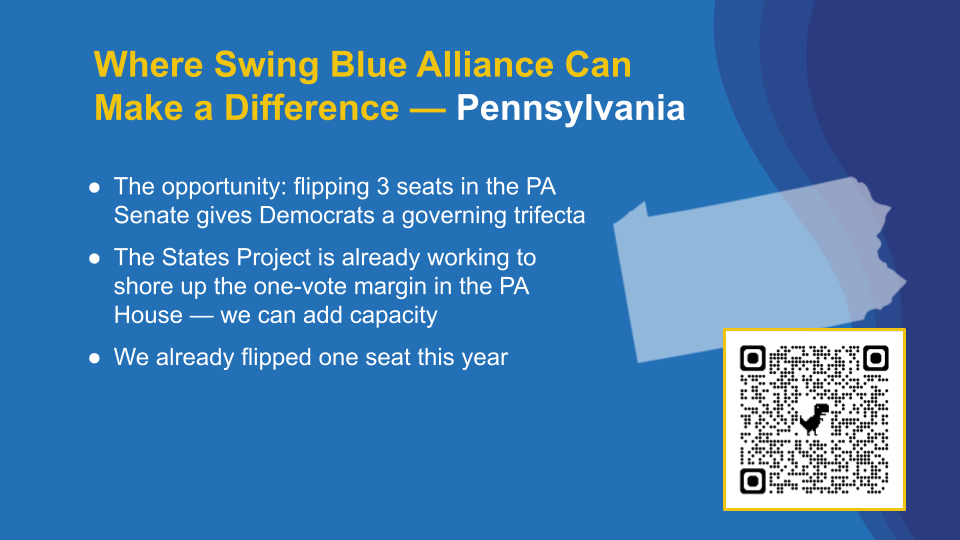
By flipping three seats in the Pennsylvania Senate, Democrats would gain a governing trifecta and could theoretically redistrict.
Next Steps
There are many more opportunities for grassroots groups to take action to lay the ground for 2028. Here’s the spreadsheet for State Level Redistricting Power, providing state-by-state analysis.
As groups choose their postcard campaigns, candidates to phone, text, and canvass for, let’s recognize the importance of working on state legislatures this election season to put Democrats in a position to respond to Republican gerrymandering in the years to come.
Allies
The States Project is focused on flipping the Arizona state legislature, rebuilding Michigan and Minnesota’s trifectas, and flipping the House in New Hampshire while shoring up Pennsylvania’s one-vote margin in the House and flipping both chambers in Wisconsin. The States Project also sees opportunities to break Republican supermajorities in Iowa, Montana, Nebraska and North Carolina.
States Win, formerly Sister District, helps grassroots groups swing key state legislative races. Their multi-year strategy aims to “put Democrats in the strongest position possible for redistricting in 2031, laying the groundwork for a post-Trump era that restores American democracy and ushers in unprecedented progress.”
Swing Left just released its Big Swing strategic plan, an expanded map that targets 46 House, nine Senate, and eight gubernatorial races in 2026, in addition to state legislative races to be announced this summer.
The DLCC, as the arm of the Democratic Party that is responsible for winning control of state legislatures, is heading up the coalition mentioned above. It released a memo in December announcing plans to spend $50 million to flip up to 650 legislative seats across 42 chambers in about two dozen states.
Susan Labandibar founded and guides the all-volunteer, grassroots organizing group, Swing Blue Alliance. She wrote the initial articles for The Grassroots Connector, founded The Field Leaders Research Network, and has spurred collaborations among grassroots groups.
Great article. I really think this year can be a massive blue wave that can take power back from this administration. But only if we're all fighting for it!
Dump them ALL out and start fresh. The Court too!