
Performance Art Advances Grassroots Activism
Pageantry has its place in the movement to preserve democracy. With this “how-to” article, Charlottesville organizers hope to inspire readers to stage their own performances.
By Isabelle McMahon and Dan Doernberg
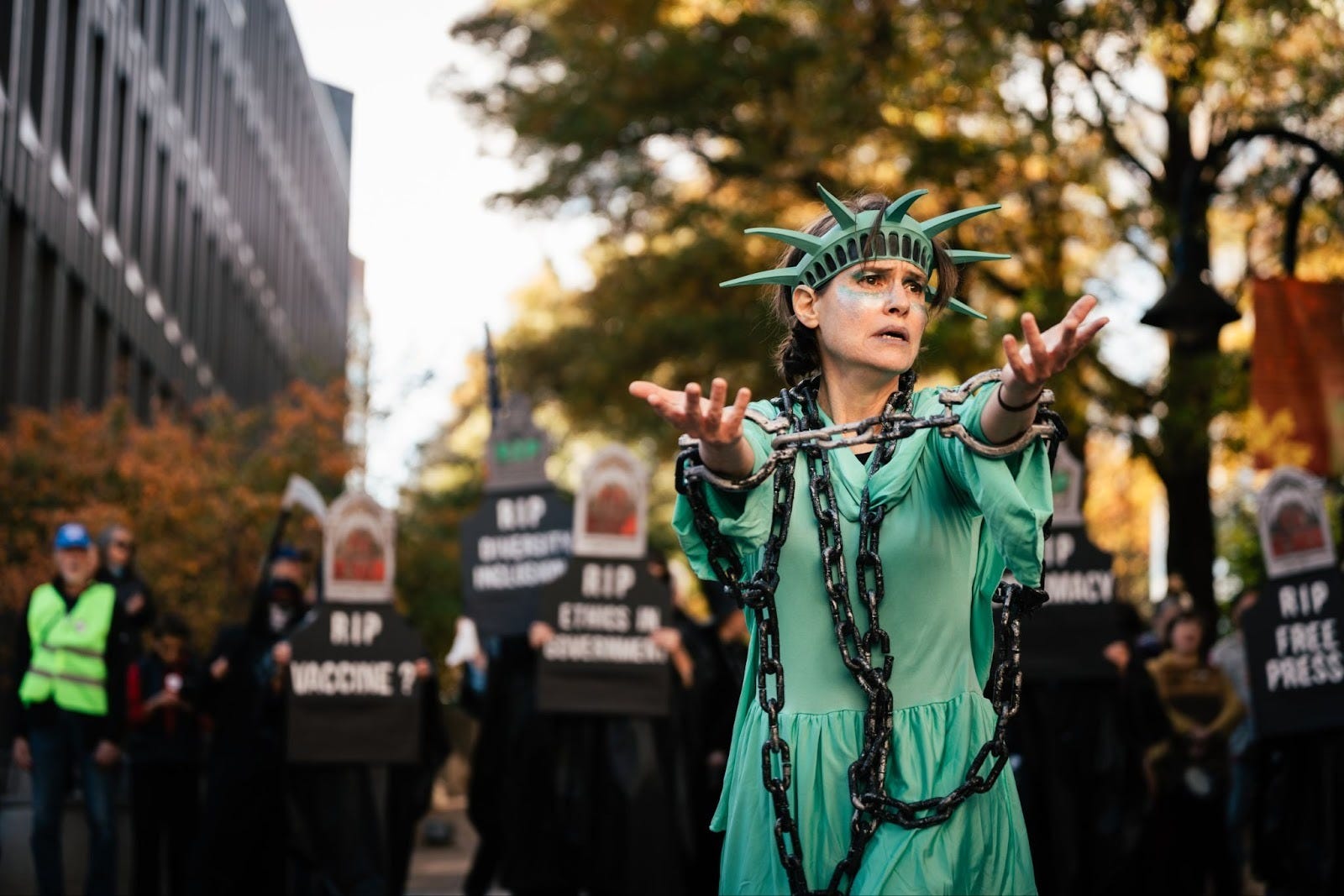
Charlottesville Indivisible recently took its message to the streets, staging a New Orleans–style “funeral for democracy” in the heart of Virginia. The November 1, 2025 event featured more than 100 performers in a 90-minute event for an audience of roughly 750 people, many of whom became impromptu participants!! The event was both a lot of work and exhilarating.
Initial Creative Phase
It all started with music. After a number of Indivisible Charlottesville members formed a Signal group to discuss how music could be used in protest movements, one member shared a video depicting a jazz funeral for democracy in Spokane, Washington. The images of bereaved marchers resonated deeply with our group and served as our inspiration to go beyond music, to imagine ways street theater could deliver powerful symbolic messages. Nancy DeWitt, a retired English teacher, felt inspired, but added, “Just doing a funeral felt too bleak to me; I wanted an element of redemption and transformation.”
Nancy involved Isabelle McMahon and other Indivisible Charlottesville members in imagining an uplifting version of a jazz procession where democracy didn’t die. They envisioned Lady Liberty as a central figure symbolizing the ongoing struggle and resilience of democracy. When it became clear that a script was needed to translate a wealth of ideas into reality, Nancy volunteered to write it, though she had never written a play before. She thus became the Creative Director. Isabelle McMahon, a get-things-done type, agreed to be Production Coordinator.
Challenge: The creative process can be overwhelming. With patience and open dialogue, differing perspectives and conflicting visions can be translated into opportunities for innovative and impactful activism.
Narrative Structure
As Isabelle and Nancy developed the creative concept of a funeral for democracy, they realized the need to articulate clear objectives within a narrative structure. Each act had an intended impact, essential for fleshing out the script as well as choosing the songs, recruiting performers, and developing the props. Isabelle and Nancy settled on a three-act structure.
Act 1, “Mourning” — Objective: raise awareness about the potential losses and setbacks we face under the current MAGA administration, highlighting the urgency of collective action.
Act 2, “Join the Movement” — Objective: Inspire confidence that both individual and group efforts can create meaningful change, encouraging others to join and support the movement.
Act 3, “Celebrate in Unity” — Objective: Foster a sense of optimism and joy within our community, showcasing how resilience and unity can inspire hope and positivity for the future.
Once they finalized the structure, the creative teams then focused on specific tasks (e.g. making and sourcing props, and choosing music).
Challenge: The story had to be meaningful and visually powerful but conveyed with minimal dialogue, since a big audience in an outdoor space would likely have trouble hearing.
Casting and Community Outreach
In the early stages, we reached out to recruit volunteers through Indivisible Charlottesville’s Facebook page, newsletters, and flyers. However, this approach didn’t yield many volunteers, leaving us worried that we would have a compelling script but no performers. So we pitched our idea to key community figures, including renowned local jazz musician and long-time University of Virginia jazz instructor John D’earth, choreographer Susan McCulley, and several choirs. All joined the project with enthusiasm. The planning moved forward.
The choirs selected songs and tunes. Susan observed choir rehearsals. As she said, “Literally millions of people have sung This May Be the Last Time, This Little Light of Mine, and This Land is Your Land and there are as many versions of each song as there are performers. I wanted to hear and feel the versions these choirs sang and then offer movement that reflected the energy of these particular performers.” The movement sequences (see videos) complemented the songs and carried a message: “We are in this together.”
Lesson learned: The most challenging aspect of organizing the event was convincing roughly 30 people to take minor acting roles. Collaborating with local performance groups is highly recommended, to leverage their structure and communication methods so the organizers don’t have to recruit, arrange meetings, and disseminate information to individuals.
Props Creation
Our event featured a variety of props that were essential for creating visual impact and conveying a clear message. These included a coffin, tombstones, protest signs, and costumes for the actors. Since making props is time-consuming, we began working on them well in advance, sourcing most materials from dollar stores. The total cost for all the props was under $500.
Lessons learned: (1) Put thought and effort into your props (consistency, quality, etc.) (2) Opting for a DIY approach with a low budget is possible, but requires more time for construction. This ambitious project required more than 100 person-hours to complete, but most projects would require fewer.
Venue and Time Selection
An essential aspect of organizing a performance art event is selecting the right venue. Charlottesville has a heavily-used downtown pedestrian mall that’s safe and accessible to a large audience, making it our ideal location.
We timed the Jazz Parade to take place on the last day of early voting in Virginia. The performance ended just yards away from the Charlottesville’s still-open early voting polling place. We wrote an encouragement to vote now into our final act.
Lesson learned: Securing a city permit and getting insurance for a political event like this were complicated processes. Start research on the required paperwork as soon as you think such an event is likely to happen! Time the event with an eye to other scheduled events that could drive participation up or compete for attendees.
Refining the scenario and rehearsal
Once we finalized the three-act structure, a small team began exploring how performers, community members, and the audience could collaboratively bring the event to life. Our creative process focused on blending art and activism to transform abstract ideas into powerful, memorable moments that would inspire and mobilize our community.
Because we couldn’t disrupt the Downtown Mall to rehearse, we didn’t have the advantage of a full run-through. Scheduling a rehearsal for so many people would have proven very difficult anyway. A few groups got together 20 minutes prior to the event for their first (and only!) run-though. To compensate for the lack of dress rehearsal, Isabelle and Nancy:
Provided each participant with a clear final script, including time cues for their specific actions.
Held a 30-minute online run-through on Zoom to help participants understand the overall flow and allow time for questions.
This decentralized approach worked, the performance went off quite smoothly.
Lesson learned: A clear and detailed script enabled each group of participants to understand their timing and role, allowing the entire 90-minute performance to run smoothly without a single full rehearsal. Not ideal, but completely doable!
Publicity

Indivisible Charlottesville decided early on to pair the Jazz Parade with a Democracy Fair, organized by a different set of Indivisible volunteers. Our idea was that promoting each event would increase attendance to both events. More than 20 service and anti-fascist organizations tabled on the Downtown Mall to publicize their efforts and garner public support. These organizations and their members also helped publicize the Jazz Parade.
A few weeks before the event, Jazz Parade organizers drafted a press release highlighting key objectives of the performance and emphasizing the roles of each group involved. Our goal was to attract media attention and secure interviews ahead of the event. We succeeded in winning coverage, which carried our message to a wider audience.
Lesson Learned: Arts and culture columnists may require two to three weeks advance notice to cover a local event, whereas a few days advance notice is generally sufficient for news departments that normally cover political rallies and events.
Social Media
Before the event, we formed a social media committee that included videographers and photographers, including a professional photographer who has given permission to use and share her amazing event photos (with credit to Rebecca George). We developed a detailed plan outlining each team member’s responsibilities to ensure all key moments were documented. We successfully produced a YouTube video within 24 hours.


Lesson Learned: Incorporating live streaming, posting reels during the event, or sharing immediate post-event content would have enhanced engagement and allowed us to connect with our audience more dynamically and in real time.
Growing Camaraderie
Event production can have a profound impact on those who contribute to its staging. As Susan McCulley notes, “Movement is part of the resistance; moving together communicates our connection to each other and to the people who are watching.” Sage Bradburn, who played Lady Liberty, paraphrased our parade leader Emily Little (see interview): “When you sing together… you’re connecting with people, you’re acting with them, you’re syncing your breath with them, you’re locking eyes with them… and that builds the kind of connections and trust that will help us get through the really difficult times.”
Conclusion
The Charlottesville Jazz Parade for Democracy was a big success, well worth the considerable time and effort our group invested. This kind of event is a great way to mobilize and engage the creative community in any town as well as create a well-attended action that will generate media buzz. Indivisible Charlottesville plans to do more of these as opportunities arise!
For more information about the event see:
NowComment links to video highlights of each act, and videos and transcripts of interviews with Nancy, Isabelle, Sage, Emily, and others who played key roles
Photo gallery of the professional photographer’s images (Images are available for use. Please credit Rebecca George.)
Complete production guide: script, stage directions, prop construction, and more.
Isabelle McMahon is a Franco-American event organizer with Indivisible Charlottesville. Shortly after the Trump administration's inauguration, she transitioned from evaluating international development projects, mainly for USAID, to applying her project management skills in activism. The Jazz Parade for Democracy was her first initiative featuring performance art.
Dan Doernberg is an organizer with Indivisible Charlottesville. In a previous life, he co-founded Silicon Valley’s landmark Computer Literacy Bookshops and led the team that developed the NowComment multimedia discussion/annotation tool.
Stories Welcome. The Grassroots Connector welcomes stories of activities and events, especially from organizers willing to share what they did and what they learned. Send ideas to thegrassrootsconnector@gmail.com
First, thank you for producing and sharing this impactful piece of guerilla theater. Second, and as important, thank you for the clearly laid out process for thinking through how to put a guerilla theater event together, including considerations, and post event lessons learned. This sharing stands as a valuable resource for others to consider trying their hand this type of production.
This is extremely interesting. I’m an artist and I’ve been trying to figure out how to combine art and activism. Thanks for this 😊🙏